We use the web every day and we do quite a bit of searching. We all know that there are some really bad websites out there and just as many mediocre ones as well. Where are all the high-quality websites? If you're working on a project for class and need a variety of good websites, how do you know which ones to choose?
One suggestion is to critically evaluate each website you visit. Find out who the author is, how accurate the information is (compare it to another site), and determine how much bias exists on the site.
Another suggestion is to try out our new Grand View Library Web Directory. This site has dozens of good websites that you can choose from when researching a topic. If you like one of the sites that you find there, let us know and we'll make sure to keep it in the future.
Good luck searching and browsing!
Showing posts with label web. Show all posts
Showing posts with label web. Show all posts
Tuesday, September 14, 2010

Wednesday, April 8, 2009
Earthquakes & Volcanoes

Have you been following the news of the Italian earthquake? A 6.3 magnitude earthquake hit central Italy and people are still searching for survivors. The quake destroyed over 10,000 homes and left over 28,000 people homeless.
With the digital technology that we have today, we can learn more about these events as they happen. The most recent newspaper articles are available through our NewsBank database as they are published. One of the most recent articles noted that the Vatican has sent in its fire brigade to help out the other Italian emergency services. People pull together in times like this.
There's also a scientific side to this story as well. The United States Geological Survey (USGS) has been monitoring the quake as well as the aftershocks. Of course the USGS has also been paying very close attention to another geological event here in the U.S.: the earthquakes and ash eruptions from Alaska's Mount Redoubt. You might think that Alaska is mainly wilderness, but Mt. Redoubt is very close to Anchorage, one of the largest cities in Alaska.
Remember that the next time an event like this happens, you have many resources to draw upon. They will give you up to the minute information when you need it.
Friday, March 6, 2009
Finance & Photos
 Happy Friday, everyone.
Have you been trying to make sense of the entire financial crisis? It's a twisted system and money seems to be flying left and right. Thankfully the Federal Reserve Bank of St. Louis has put together a timeline of the financial crisis. It's an engaging website with documents and other information pertaining to the nation's continuing efforts to control the economic swings.
Also, do you like old photographs? Do you need old photographs for a project in one of your classes? If so, the Library of Congress now has a huge archive of photos on its Flickr account online. You can see color photos from the Great Depression in one of their collections.
They also have a new collection of photos of Abraham Lincoln, from when he was a young lawyer all the way up to the days before his assassination.
Tuesday, February 17, 2009
Tracking Information: Our National Stimulus
Have you been following the passage of the American Recovery and Reinvestment Act? Well, you probably are but you know it by a different name: the stimulus.
Yes, we are in rough economic times, and that means colleges and universities all across the nation will feel the pinch as well.
How will the new stimulus affect colleges and universities? Well, you could read a news article about it from our database Access World News.
Or you could follow the money by visiting the government's new website, Recovery.gov.
You can also find out how the stimulus package is going to directly affect Iowa. The Democratic Policy Committee has put together fact sheets for each state in the Union, showing how the money will impact our state. Check it out.
So test out your research skills and follow that money! Find out how it will impact you, your friends, your family, your school, and your community.
Thursday, February 12, 2009
Darwin & Lincoln


Today we celebrate the 200th anniversary of the birth of Charles Darwin and Abraham Lincoln.
These two men impacted history in unique ways. Without their efforts, we would certainly be living in a very different world with different perceptions of the people around us.
Lincoln and Darwin helped us to see ourselves in a new way. Darwin's theory of evolution gave us a glimpse of ourselves as being part of nature and the product of millions of years of evolution. No one human being is genetically superior or inferior to another. We are all alike.
Lincoln changed the United States like no one before or after him. His efforts as the 16th president of our republic helped secure the freedom that American slaves had wished for. He was a man of his time with faults and failings, but he was also ahead of his time, especially in his writing ability. His ultimate goal was to preserve the union, but in the process he helped lay the foundation for a multicultural America in which people are treated equally.
Lincoln and Darwin helped us to see that we are all equal. Let's remember that on this day in history.
For more information about Darwin and Lincoln, check out some of the many books we have here at the Grand View library. Also, take a look at some of these excellent websites devoted to the lives of these men:
Monday, February 2, 2009
Happy Groundhog Day!

Happy Groundhog Day! Why do we rely on a little mammal like this to tell us what our weather is going to be like? Well, that's a story that's about 110-years old.
There is an old tradition from Europe, called Candlemas, which some historians believe is the root of Groundhog Day. Candlemas falls roughly halfway between the Winter Solstice and the Vernal Equinox. In other words, it's the mid-point of winter. According to ancient German stories, this was the day that animals like badgers, bears, and, oh yes, groundhogs, came out of their little dens to see if it was warm enough to come out permanently.
In the United States, the tradition has been going on for about 110 years. Punxsutawney Phil, the modern groundhog who we celebrate, saw his shadow today, which means another 6 weeks of winter. In the past 110 years, the ancestors of Phil have seen their shadows 96 times and not seen it 14 times.
If you're interested in an article from one of our databases on the history of it, check out this link.
Monday, January 19, 2009
Dr. Martin Luther King, Jr.

Today we celebrate the life and work of Dr. Martin Luther King, Jr. Dr. King worked tirelessly throughout his life seeking social justice for African-Americans and the impoverished in the United States.
Dr. King did much of his early work in the American South, but moved on into Northern states and the nation's capital to preach his message. His "I Have a Dream" speech is one of the most famous speeches of the past 50 years and is often quoted by freedom fighters and civil disobedience groups today.
Sadly, Dr. King's life came to a shocking end in Memphis, TN when he was assassinated. However, his work continues to this day, all over the globe. If you want to learn more about his work and how you can be a part of it, visit the King Center's website.
If you wish to learn more about the man and his life's work, visit the Grand View Library. We have a number of books on the life of Dr. King, including At Canaan's Edge and God and human dignity : the personalism, theology, and ethics of Martin Luther King, Jr.
There is also an excellent newspaper archive in which you can relive Dr. King's life, day by day.
Finally, if you're interested in the Civil Rights Movement in the United States, check out some of the resources available at the website of the Library of Congress.
Tuesday, January 13, 2009
Inauguration Day 2009
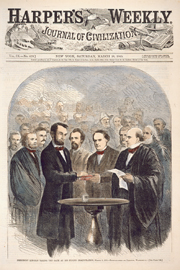
It's been four years and another inauguration is just around the corner. One week from today President-Elect Barack Obama will take the oath of office at noon, making him the 44th president of the United States of America. Huge crowds of people are expected in Washington, D.C. and people from all over the world will tune in to see the new president.
But why January 20th? And what else is going to happen that day? It's time to answer a few questions with some excellent websites.
Inauguration Day is an American tradition dating back to George Washington's inauguration on April 30th, 1789. It was then that President Washington added the words "so help me god" to the end of his oath, and kissed the Bible afterwards.
President Lincoln's 2nd inaugural (pictured here) gave the country one of the finest speeches and a time to heal after the Civil War.
The 20th amendment to the Constitution, ratified in 1933, stipulated that the President would take office on January 20th. Before that, almost all inaugurations took place on March 4th. Imagine all that time between the election and the inauguration!
If you want to read more about the inauguration, check out the Library of Congress' special digital collection. It's filled with documents from Washington to Bush.
If you want to learn more about the schedule of events for inauguration day or more about the new first family, check out the government's USA.gov site. They have a one-stop-shop for everything you need to know, from all the musical acts, to when the speeches will be given.
We'll have more posts in the future on current events and library resources and/or websites that feature those topics.
Tuesday, December 23, 2008
Helpful Tools
Our blog is about more than just reporting what's going on in the library. This is also a great place to visit to find out about new resources on the web as well. Here are a few examples:
Our library website contains dozens of links to our catalog, various databases, online resources, and email contacts. Visiting our website and bookmarking it is an excellent idea. However, sometimes you need a resource quickly and you don't want to follow the bookmark and click through to the proper page. That's where our new browser toolbar comes in handy. You can download it quickly to your Internet Explorer or Firefox browser. It will then allow you to access all of our resources with one click! Try it out.
Do you use the library computer lab frequently? If so, you'll want to keep your eye on our calendar for the lab. As you probably know we teach classes in the lab from time to time. Now you can know exactly when the lab will be open and when a class might be using it. Bookmark this link and check the calendar whenever you plan to use our lab. Remember: this calendar is on MyGVC, so it will prompt you for your username and password if you click on it from off-campus.
We know you have questions about your class work and your research. Our job is to help you answer those questions. We check our email all the time, so feel free to send us a question and we'll get right back to you.
Check back here to see our next blog post. We'll have more resource links like this from time to time, including what's new on the web.
Subscribe to:
Posts (Atom)